WASHINGTON, D.C. — A shocking new “confidential but accidentally forwarded” poll released this week suggests that millions of registered Democrats are secretly supportive of Donald Trump — but remain in hiding out of sheer survival instinct.
The study, conducted by the nonpartisan Institute for Extremely Awkward Thanksgiving Dinners, found that roughly 18% of self-identified Democrats admit they’ve said the phrase, “I mean… he kind of has a point,” before immediately glancing around the room like they’d just insulted Beyoncé.
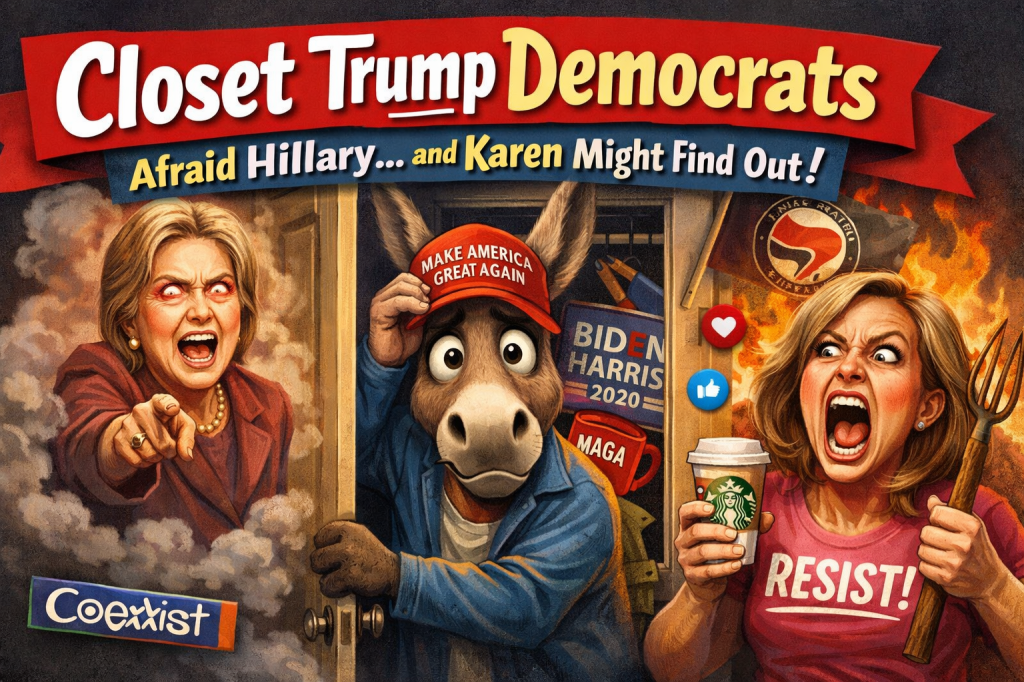
According to researchers, these “Closet MAGAcrats” live in constant fear of being exposed by what one respondent described as “a hyper-alert book club moderator with a ‘Coexist’ bumper sticker and a direct line to the neighborhood group chat.”
Living in the Political Shadows
One anonymous respondent from suburban Maryland described his daily routine:
“I keep a Biden yard sign out front. But in the garage? There’s a folded-up red hat hidden inside a reusable Whole Foods bag. I can’t risk it. Karen across the street has binoculars.”
The report indicates most closet Trump Democrats operate under strict secrecy protocols:
- They “accidentally” criticize inflation but quickly blame “late-stage capitalism.”
- They say “We need border solutions,” but whisper it into a couch cushion.
- They clap when someone mentions tax cuts — but only with internal applause.
Researchers found the primary deterrent to “coming out” politically was not policy disagreement — but social retaliation.
“Participants feared immediate exile from wine nights, HR investigations over LinkedIn likes, and being unfollowed by someone with pronouns in their bio,” the report states.
The Hillary Factor
The study’s most dramatic finding involved the lingering psychological influence of Hillary Rodham Clinton.
Though she holds no current office, respondents described her as a kind of mythological figure — a political Voldemort whose name is spoken in hushed tones during faculty meetings.
“Every time I think about saying something positive about Trump,” one Democrat confessed, “I picture Hillary materializing behind me in a pantsuit, slowly adjusting her glasses.”
Political scientists were quick to clarify that there is no evidence Clinton commands any sort of secret enforcement brigade — though they admitted “the group chat energy can be intense.”
The Raging White Liberal Woman Index™
Perhaps the most controversial portion of the study was the newly created RWLI™ — the “Raging White Liberal Woman Index.”
The index measures:
- Number of times someone says “problematic” per hour.
- Willingness to weaponize a Facebook post from 2012.
- Speed at which someone can organize a boycott of a local bakery.
The higher the RWLI™ in a zip code, the lower the likelihood of a Democrat publicly defecting.
In highly indexed areas, political dissent is not met with debate — but with a 27-slide Instagram infographic.
Experts Weigh In
Political sociologist Dr. Harold Whitmore explained:
“This isn’t about policy. It’s about social survival. Humans fear ostracism more than taxes. If expressing mild appreciation for Trump risks being removed from the PTA Slack channel, most people will choose silence.”
Meanwhile, Republican strategists are reportedly exploring a new outreach slogan:
“It’s OK. We Know You’re In There.”
A Nation of Political Cosplayers
The study concludes that American politics has evolved into a kind of performative theater, where:
- Some Republicans pretend to hate Taylor Swift more than they actually do.
- Some Democrats pretend they’ve read all 900 pages of the latest climate bill.
- And millions quietly scroll both Truth Social and NPR.
As one anonymous respondent summed it up:
“I don’t even know what I am anymore. I just want affordable groceries and to not get yelled at.”
Whether the phenomenon is real or just another internet fever dream remains unclear. But one thing is certain:
In 2026 America, the scariest thing isn’t crossing party lines.
It’s crossing the wrong group chat.
Keep Political Party Animals Free
Political Party Animals exists to laugh at politics so we don’t cry about it. Satire, parody, and absurdity are how we call out hypocrisy, nonsense, and the occasional clown show in public life.
If this piece made you laugh, groan, or say “yep, that tracks,” reader support helps keep the satire sharp and independent.

 Political Party Animals