POTOMAC RIVER BASIN — In a shocking development that experts are calling “entirely predictable,” thousands of residents who have spent the last decade flushing baby wipes labeled “Do Not Flush” are now demanding accountability after a massive wastewater pipe burst, sending millions of gallons of untreated sewage into the Potomac River.
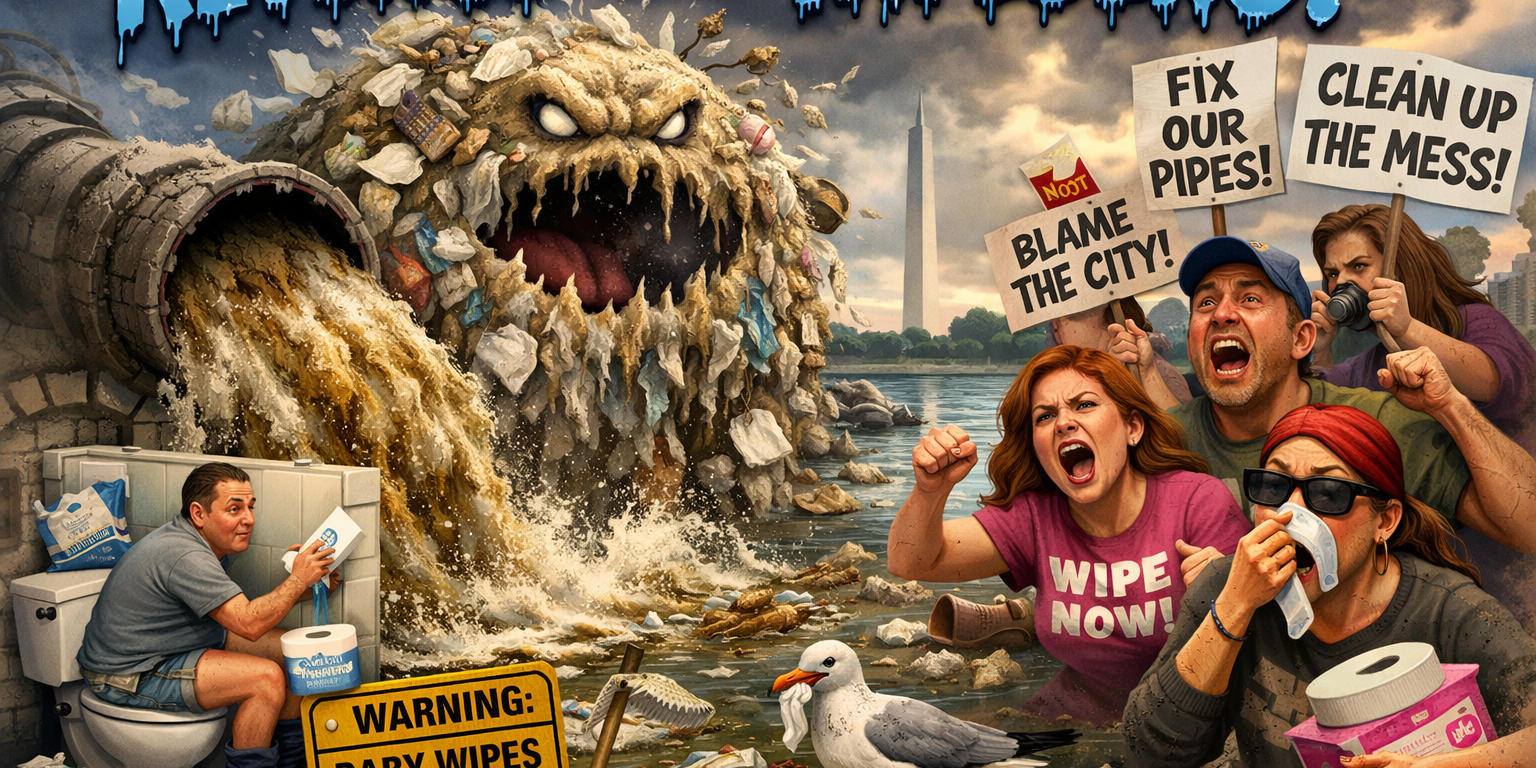
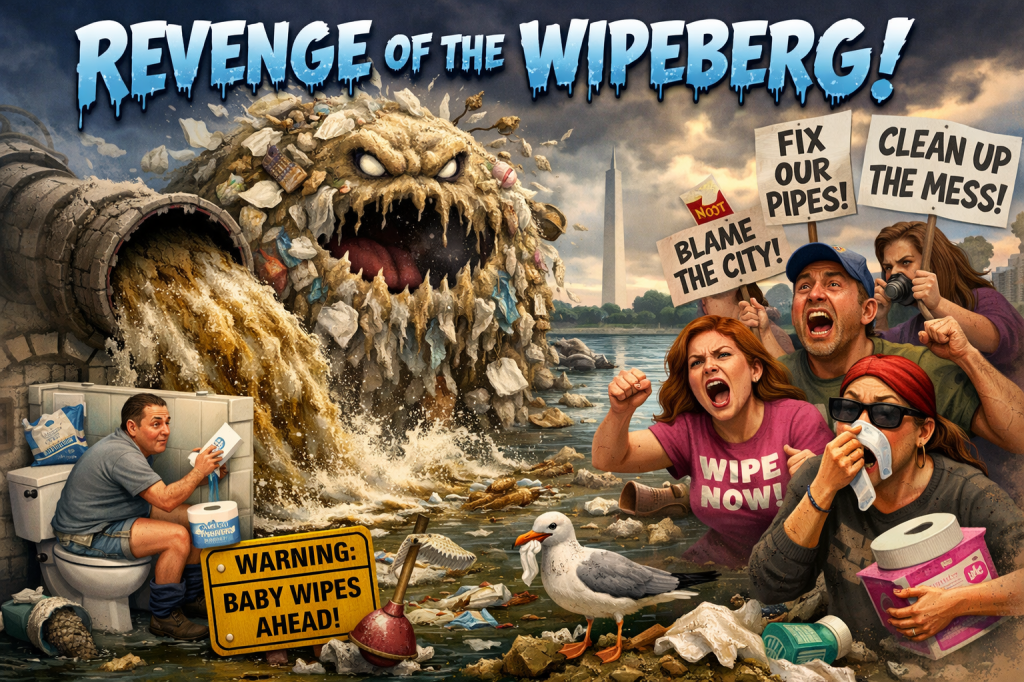
Officials say the rupture was caused by a 10-ton “wipeberg” — a hardened mass of “flushable” baby wipes, paper towels, dental floss, and what one engineer delicately described as “hope.”
Residents, however, are not accepting responsibility.
“This is a total infrastructure failure,” said one local homeowner, standing next to a Costco-sized pallet of lavender-scented baby wipes. “If the system can’t handle 47 wipes a day from each household, maybe we need a better system.”
“They Said Don’t Flush. But They Didn’t Mean Me.”
Municipal utilities have been warning for years that baby wipes — even the ones labeled “flushable” — do not break down like toilet paper.
But many residents insist they were misled.
“The package said ‘safe for septic,’” said another resident. “I just assumed that meant safe for rivers, ecosystems, and the Chesapeake Bay too. It’s called faith in labeling.”
When shown a public service announcement from 2018, 2020, 2022, and 2025 warning against flushing wipes, several residents responded by saying the font wasn’t aggressive enough.
“They should’ve used red letters,” one man said. “Or maybe an animated raccoon crying.”
The Birth of the Wipeberg
City engineers described the clog as “a masterpiece of collective denial.”
“It started with a few wipes,” said one wastewater technician. “Then more wipes. Then paper towels. Then ‘biodegradable’ cleaning cloths. At one point we found a toddler sock. We don’t ask questions anymore.”
The wipeberg reportedly grew so dense it developed “structural integrity.” Officials briefly considered listing it on the historical registry before it ruptured a 60-inch pipe.
Environmental activists have dubbed the spill “Wipegate.”
Protesters Demand Immediate Solutions
Ironically, many of the same residents who dismissed warnings are now leading protests demanding urgent upgrades to “crumbling infrastructure.”
Holding signs reading “Fix the Pipes!” and “Clean Water Now!” protesters insisted the government should have built a sewer system capable of digesting entire diaper aisles.
“This is what my taxes are for,” said one protester. “To handle whatever I decide to flush.”
When asked whether they would stop flushing wipes going forward, most respondents declined to comment and clutched their bulk packs more tightly.
The Science Nobody Wanted to Hear
Experts explain that toilet paper is designed to disintegrate rapidly in water. Baby wipes, by contrast, are engineered to stay intact while scrubbing a human being.
“This isn’t complicated,” said one environmental scientist. “If it’s strong enough to exfoliate a toddler, it’s strong enough to survive your plumbing.”
Nevertheless, social media has exploded with theories blaming:
- Climate change
- Budget cuts
- Corporate greed
- A “conspiracy by Big Toilet Paper”
- Mercury in retrograde
Notably absent from trending explanations: individual behavior.
The New Awareness Campaign
In response, local utilities have launched a new educational initiative titled:
“Only Three Things Should Go Down the Toilet: Pee, Poop, and Paper.”
Early focus group testing suggests residents prefer a revised slogan:
“If It Fits, It Ships.”
Officials are not optimistic.
“We could literally tattoo ‘DO NOT FLUSH WIPES’ on people’s foreheads,” one sewer manager sighed. “They’d still do it. And then blame the tattoo industry when the pipes explode.”
Meanwhile, The River
Cleanup crews are working to contain contamination in the Potomac River, while environmental groups urge residents to reduce pollution.
Residents have responded by demanding bottled water subsidies.
At press time, warehouse stores across the region reported record sales of baby wipes — “just in case.”
Engineers confirm they are preparing for what they call “Wipeberg 2: Electric Flush.”
Moral of the Story:
The sewer system was never designed to withstand the unstoppable force of a population convinced that “flushable” means “someone else’s problem.”
Keep Political Party Animals Free
Political Party Animals exists to laugh at politics so we don’t cry about it. Satire, parody, and absurdity are how we call out hypocrisy, nonsense, and the occasional clown show in public life.
If this piece made you laugh, groan, or say “yep, that tracks,” reader support helps keep the satire sharp and independent.

 Political Party Animals