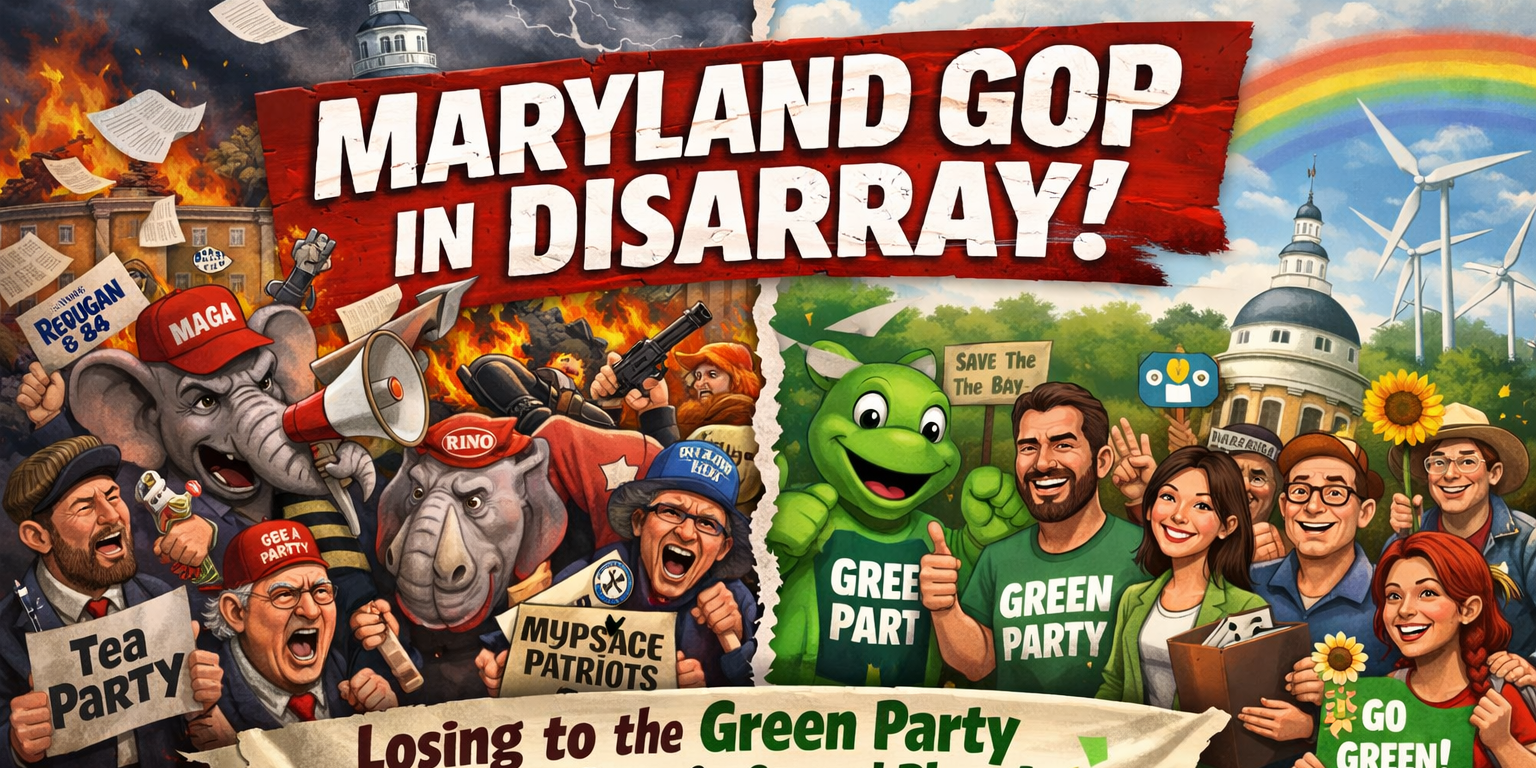
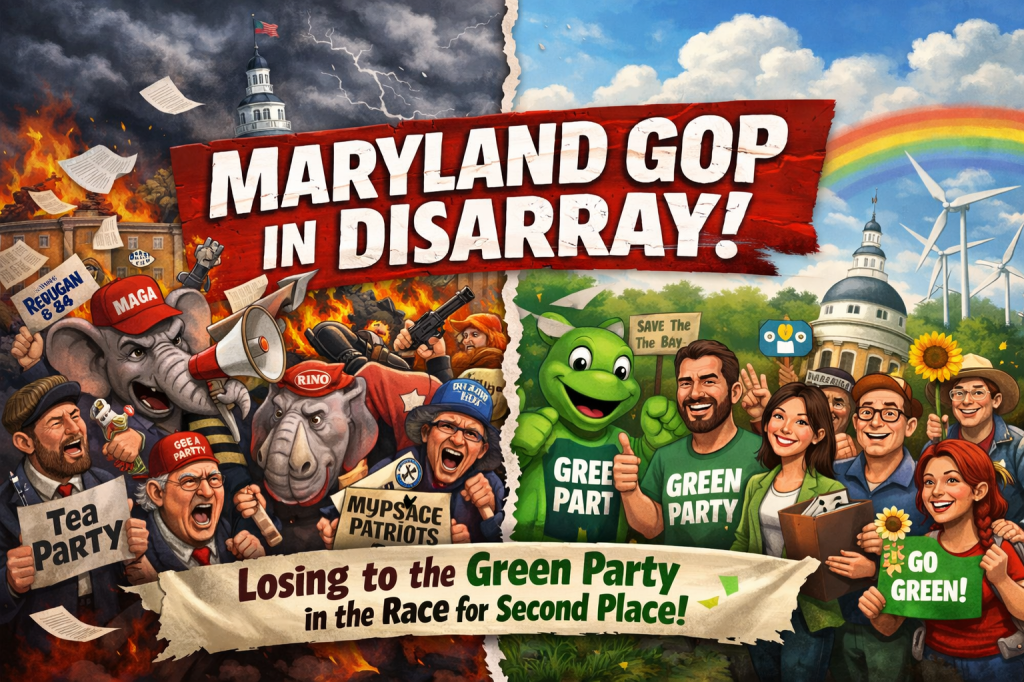
Maryland politics has always been a two-party sport with a generous helping of déjà vu. But in 2026, something strange is happening in the Old Line State: the Maryland Republican Party is in danger of being leapfrogged by the Green Party of Maryland—not because the Greens suddenly figured out how to win statewide, but because Republicans are busy holding a multi-ring ideological cage match in the parking lot.
The prize? Control of the direction of “right-leaning conservative, I-just-like-the-color-red” voters. The competitors? Everyone.
Meet the GOP, Now With 14 Sub-Parties and Counting
On any given Tuesday night in Maryland, the GOP resembles a family reunion where no one remembers why they’re related and everyone brought their own bylaws.
There are the Reagan Republicans, who believe the problem is that no one’s said “Morning in America” loudly enough since 1984.
The MAGA Republicans, who believe the problem is everyone else, especially the Reagan Republicans.
The Tea Party Republicans, who believe the problem is spending, except the spending they like.
The Freedom Caucus Republicans, who believe the problem is insufficient freedom, particularly for the Freedom Caucus.
The RINOs, who are either undercover Democrats or just people who read spreadsheets.
The Libertarians, who are technically not Republicans but keep showing up to meetings to remind everyone that roads are a mistake.
The Republican Socialists, who insist this is a real thing and ask for speaking time.
And finally, a rotating cast of activists with at least three followers and a MySpace account who demand the party “return to its roots,” despite joining last Thursday.
Each group has a logo. Each group has a Slack. Each group believes it represents “the real base.” None of them can agree on what the base actually is, where it lives, or whether it should vote.
Strategy by Committee, Outcome by Accident
While Democrats run Maryland like a long-established HOA—firm rules, high fees, and no appeals—the GOP has opted for radical decentralization. Very radical. So radical that every faction has its own press release condemning the other factions’ press releases.
The result is a party platform that reads less like a governing document and more like a Reddit thread where everyone downvoted everyone else.
Voters asking simple questions—What do Republicans stand for in Maryland? Taxes? Schools? Crime? Roads?—are politely redirected to a two-hour podcast hosted by a county chair who insists the real issue is a parliamentary slight from 2017.
Enter the Green Party, Wearing a Hard Hat and Carrying a Clipboard
Into this vacuum stroll the Greens, who don’t need to win—only to appear functional.
They show up with:
- One message
- One press release
- One meeting agenda
- Zero internal coups that week
In a state where Republican voters are watching their party debate the purity of red hats while Democrats debate which committee should debate the budget, the Greens are quietly becoming the adults in the room. Not powerful adults. Not winning adults. But coherent adults.
And in Maryland, coherence is disruptive innovation.
The Voters Caught in the Middle
Meanwhile, there’s a large bloc of Marylanders who are not ideological maximalists. They’re not looking to overthrow capitalism or privatize the moon. They just want lower taxes, safer neighborhoods, functioning infrastructure, and a government that doesn’t treat them like a line item.
These voters wander into GOP meetings, hear a 40-minute argument about who betrayed whom on Twitter, and quietly back away—only to discover the Green Party table has pamphlets, snacks, and a person who says, “Here’s what we’re running on.”
Is it perfect? No.
Is it organized? Shockingly, yes.
A Historic Achievement, If It Happens
If the Maryland GOP does manage to fall behind the Green Party statewide, it will be a remarkable feat—achieved not through electoral defeat, but through self-inflicted fragmentation.
Historians will study it. Consultants will bill for it. Podcasts will argue about it. And somewhere, a county central committee will form a task force to investigate why forming task forces didn’t work.
Until then, the Greens keep climbing, Democrats keep governing, and Republicans keep caucusing—against each other.
In Maryland politics, the most endangered species isn’t bipartisanship.
It’s agreement within the party that’s supposed to oppose the party in power.
Keep Political Party Animals Free
Political Party Animals exists to laugh at politics so we don’t cry about it. Satire, parody, and absurdity are how we call out hypocrisy, nonsense, and the occasional clown show in public life.
If this piece made you laugh, groan, or say “yep, that tracks,” reader support helps keep the satire sharp and independent.

 Political Party Animals