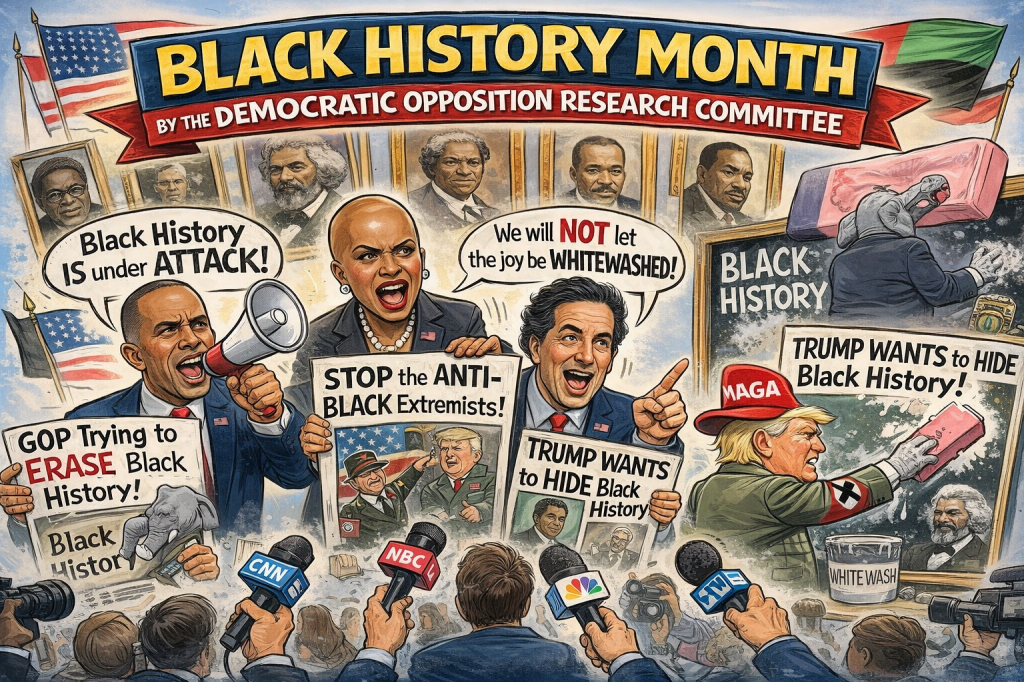
Every February, America pauses to reflect on Black history—its triumphs, its struggles, its complexity, and, apparently, its usefulness as a convenient all-purpose political cudgel.
This year’s theme, judging by social media, appears to be: “Black History Is American History (and Also About Donald Trump Somehow).”
Leading the charge is Hakeem Jeffries, who solemnly reminds the nation that Black history is American history—before pivoting effortlessly into a warning that “Republican extremists” are lurking nearby with buckets of whitewash, ready to repaint Frederick Douglass as a Fox News intern.
The message is clear: honor the past, but only if it can be weaponized against the present.
Meanwhile, Ayanna Pressley reassures the public that Democrats will “not let this anti-Black administration take away our joy.” The administration in question, for clarity, is one that has not yet managed to confiscate joy, but has apparently come dangerously close through executive orders, budget negotiations, or possibly vibes.
Joy, it seems, is now a federally protected emotion—endangered, fragile, and under constant threat from conservative talking points.
Then there’s Jamie Raskin, who helpfully explains that celebrating Black History Month now requires resisting “censorship” by loudly, proudly, and repeatedly reminding everyone that Black history is American history—which, notably, no one in the room had disputed before the tweet was written.
The pattern is hard to miss.
Black History Month has become less about history and more about press releases with a civil rights font. The giants of Black history—Woodson, Douglass, King, Tubman—are wheeled out not as thinkers or leaders, but as rhetorical body armor. Their lives are flattened into hashtags. Their disagreements erased. Their inconvenient ideas quietly skipped.
The past is no longer something to study. It’s something to deploy.
And, like clockwork, the villain of the month is the same familiar boogeyman: Donald Trump, his “toadies,” and whichever Republican last asked a question about curriculum standards. Every Black achievement, every historical milestone, every cultural contribution must now be framed as something Republicans are actively trying to erase—usually without specifying when, where, or how.
It’s less “Know Your History” and more “Know Your Enemy.”
What gets lost in this annual performance is the actual substance of Black history: fierce debates within the Black community, ideological diversity, self-reliance movements, religious traditions, conservative thinkers, radical thinkers, and everything in between. Black Americans were never a monolith—and they certainly weren’t waiting for modern political parties to grant them moral legitimacy.
Ironically, the very reduction Democrats warn against—“flattening” Black history—is precisely what this ritual accomplishes. History becomes a prop. Memory becomes messaging. And Black History Month becomes a four-week opposition ad with footnotes.
By March 1st, the tweets will stop. The urgency will fade. The joy will be declared safe again. And Black history will quietly return to storage until next February, when it can once more be rolled out, polished up, and aimed squarely at the nearest political opponent.
Because nothing honors a rich, complex, and deeply American history quite like using it to score points in the present.
Keep Political Party Animals Free
Political Party Animals exists to laugh at politics so we don’t cry about it. Satire, parody, and absurdity are how we call out hypocrisy, nonsense, and the occasional clown show in public life.
If this piece made you laugh, groan, or say “yep, that tracks,” reader support helps keep the satire sharp and independent.

 Political Party Animals