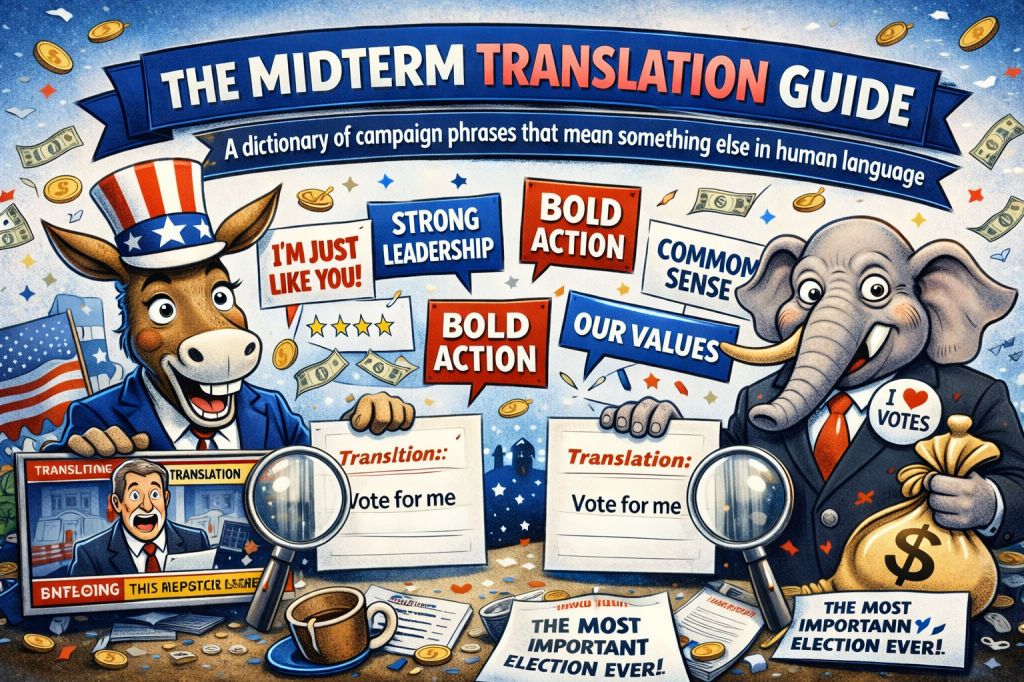
A dictionary of campaign phrases that mean something else in human language
Because if politicians spoke plainly, campaigns would last about twelve minutes.
A note before we begin
Campaign language is not designed to inform you.
It is designed to signal, reassure, alarm, or buy time.
This guide exists to translate the most common phrases you’ll hear during the 2026 midterms into something closer to what they actually mean — not cynically, just realistically.
Think of it as closed captions for democracy.
The Dictionary
“Fighting for you”
Translation:
Talking about you while fundraising from someone else.
No fighting will occur. At most, a strongly worded letter may be drafted.
“Common sense”
Translation:
“My opinion, presented as self-evident truth.”
If it were truly common, it wouldn’t need to be repeated this often.
“Putting people over politics”
Translation:
“Please forget my voting record for the next 90 days.”
This phrase peaks during election season and disappears immediately after certification.
“Holding the other side accountable”
Translation:
“I am not passing legislation, but I am very serious on television.”
Accountability usually means a press conference, a tweet, or a committee hearing that ends quietly.
“This is the most important election of our lifetime”
Translation:
“This election is important, but we need you emotionally activated right now.”
This phrase renews every two years like a subscription you forgot to cancel.
“Protecting democracy”
Translation:
“My preferred outcome, framed as a moral necessity.”
The definition of “democracy” may change depending on who wins.
“Dangerous extremist agenda”
Translation:
“An attack ad is about to start.”
The word dangerous will not be defined. The word agenda will be implied to include everything.
“Standing with working families”
Translation:
“I am for good things and against bad things.”
Which families, what policies, and how this standing occurs will be clarified later, possibly never.
“We need bold action now”
Translation:
“We have no realistic path to pass this, but it polls well.”
Boldness is inversely proportional to legislative viability.
“A threat to our values”
Translation:
“Something you disagree with, elevated to an existential crisis.”
The values in question will remain abstract for maximum flexibility.
“I’m not a politician, I’m a problem solver”
Translation:
“I am absolutely a politician.”
This phrase is often followed by a biography involving business, the military, or a childhood anecdote involving hard work.
“The polls show momentum”
Translation:
“One poll moved half a point and we would like attention.”
Momentum is a feeling, not a destination.
“This race is too close to call”
Translation:
“Please keep watching through the commercial break.”
It may also mean the margin is within the margin of error, which everyone will ignore.
“We’re reaching across the aisle”
Translation:
“We spoke to someone once and would like credit forever.”
Bipartisanship is often a photograph, not a process.
“I hear your concerns”
Translation:
“I am acknowledging you without committing to anything.”
This phrase is legally binding only in tone.
“This changes everything”
Translation:
“This changes the next news cycle.”
Everything remains mostly the same.
Why this language persists
Campaigns do not reward clarity.
They reward:
- emotional response
- narrative simplicity
- repeatability
- plausible deniability
Plain language limits flexibility.
Vague language travels better.
That’s not a conspiracy — it’s an incentive structure.
How to use this guide
You don’t need to become cynical.
You just need to listen differently.
When you hear a phrase:
- Translate it.
- Ask what’s being avoided.
- Look for specifics — timelines, votes, budgets, authority.
If none appear, you’ve learned something anyway.
Coming up next
In the next chapter, we’ll tackle The Campaign Ad Decoder — where we break down attack ads, inspirational ads, and the mysterious genre known as “concerned narrator over black-and-white footage.”
You’ll never hear ominous piano music the same way again.
This series is satire. For actual voting rules, deadlines, and registration requirements, consult your state or local election authority.

 Political Party Animals