
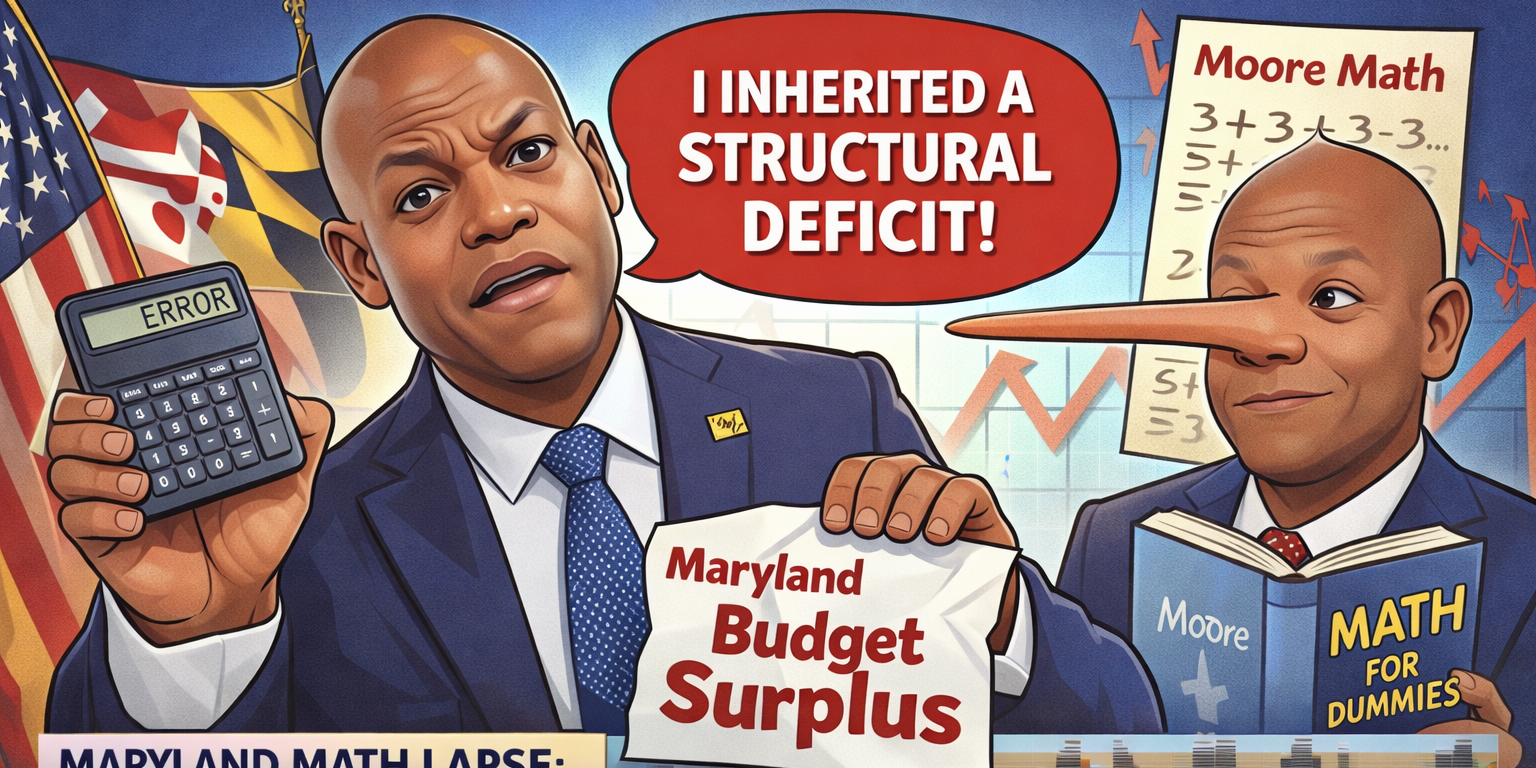
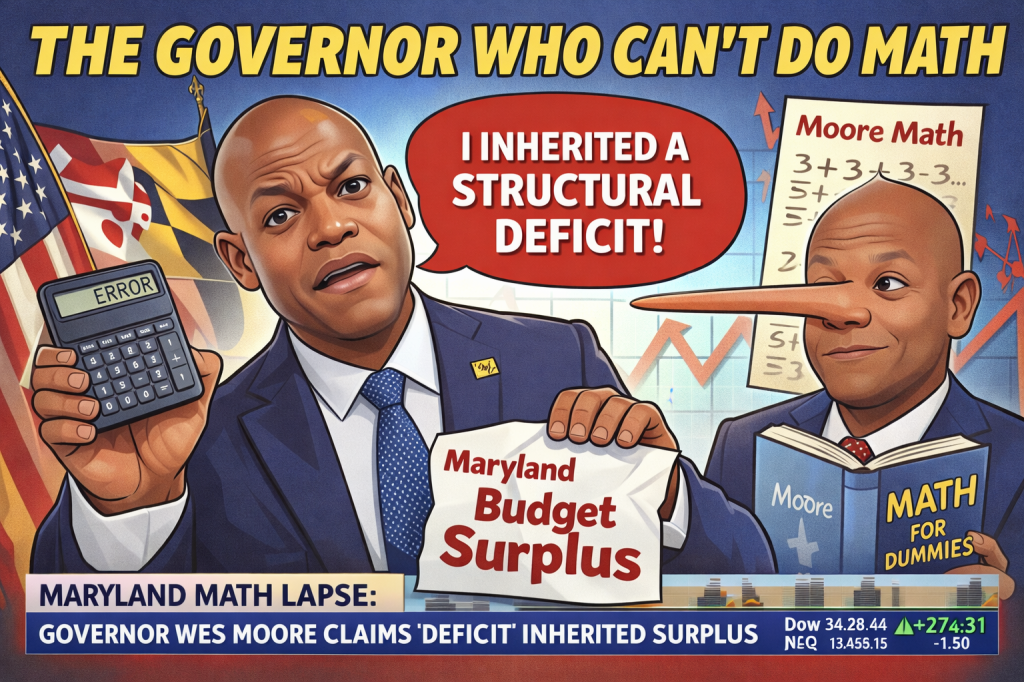
By the time Governor Wes Moore finishes a sentence about the state budget, Marylanders are left with a familiar question: Is this a press conference… or a performance art piece about numbers?
Once again, the governor has assured the public that he “inherited a structural deficit.” Not a small one. Not a temporary one. A full-blown, ominous, math-confirmed deficit. “That’s not my opinion,” he says. “It’s math.”
Which is impressive, because the math appears to be imaginary.
The Magical Disappearing Surplus
When Governor Moore took office, Maryland wasn’t scraping couch cushions for spare change. The state had a multi-billion-dollar surplus—the kind politicians usually take selfies with. A surplus so large it practically needed its own ZIP code.
Yet somehow, in Moore Math™, a surplus became a deficit the moment he placed his hand on the Bible.
This is a bold accounting strategy. If adopted widely, Americans could finally solve inflation by declaring their bank accounts “structurally misunderstood.”
“Balanced Budgets” and Other Bedtime Stories
The governor proudly touts four consecutive “balanced budgets,” which sounds responsible until you remember Maryland is constitutionally required to balance its budget. That’s like bragging about stopping at red lights.
But Moore adds flair: “reining in spending” and “growing the economy.” Reining it in, apparently, by increasing spending. Growing the economy, apparently, by watching GDP sit motionless like a confused crab on the Chesapeake Bay.
CNBC summed it up perfectly with an accidental truth bomb:
“But the GDP did not move.”
That chyron should be bronzed and mounted in the State House.
The Deficit That Lives Rent-Free in His Head
Marylanders might be forgiven for wondering why the governor keeps insisting he inherited a deficit when public records, fiscal notes, and basic arithmetic all disagree.
Possible explanations include:
- A calculator that only subtracts.
- A deep philosophical belief that money is a social construct.
- Or a PowerPoint slide labeled “Deficit” that was never updated but feels emotionally correct.
In Moore’s defense, calling it a “deficit” is politically useful. If everything is broken when you arrive, anything that happens afterward can be framed as heroism. Roads crumble? Structural deficit. Taxes rise? Structural deficit. Your sandwich costs $18? Believe it or not—structural deficit.
Math Isn’t Political. But This Is.
The governor insists this isn’t opinion—it’s math. Which is true. Math isn’t partisan. Two plus two does not caucus with anyone.
That’s the problem.
Marylanders can read budget documents. They can see the surplus that existed, the spending increases that followed, and the economic growth that stubbornly refused to show up for work. At some point, repeatedly calling a surplus a deficit stops being spin and starts sounding like someone hoping the voters don’t check the receipts.
Final Tally
Maryland doesn’t have a math problem. It has a messaging problem—and a governor who treats arithmetic like an optional elective.
The numbers are what they are. You can’t just rename a surplus because it’s inconvenient to the storyline.
That’s not politics.
That’s not leadership.
And despite what we’re told—it’s definitely not math.

 Political Party Animals