
In a quiet cul-de-sac just outside Minneapolis—where the snowplows arrive early, the yard signs argue loudly, and the hotdish is legally binding—lived a boy named Nick Shirley. Nick was mostly normal, if you ignored the psychokinesis, the nosebleeds, and the way he could flip a city council meeting table with a thought.
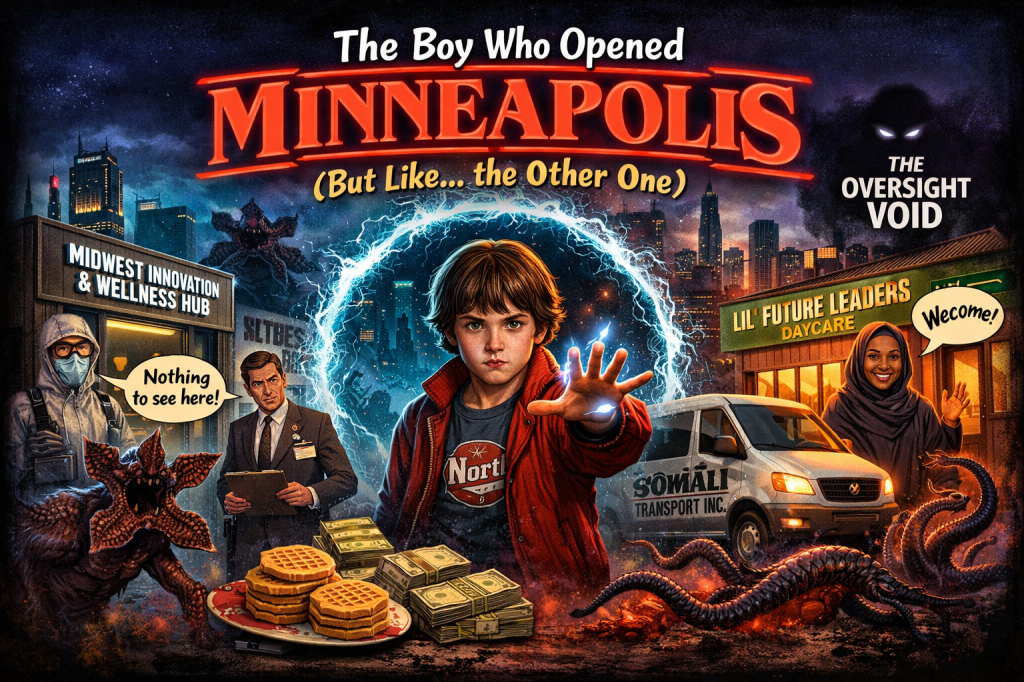
Nick’s talents were discovered, as these things usually are, during standardized testing. He circled all the answers at once. The proctor fainted. A clipboard caught fire. And just like that, Nick was gently escorted (by men in fleece vests with “Community Engagement” badges) to a nearby human experimentation facility known publicly as the Midwest Innovation & Wellness Hub™.
Privately, it was a lab.
A very labby lab.
Deep beneath its artisanal concrete floors, Nick was taught to focus his mind. “Picture a door,” the scientists said. “Now open it.”
Nick did.
And Minneapolis broke.
A gateway ripped open, revealing a hostile alternate dimension quickly dubbed The Upside Down Minneapolis—a place where the skyline looked familiar but wrong, the lakes whispered subpoenas, and every streetlight flickered like it was about to issue a press release.
It felt a lot like Stranger Things, except with more task forces.
Inside this shadow-city, Nick discovered something astonishing.
Entire industries.
Rows and rows of daycare centers, learing centers, transportation companies, and nonprofit-looking storefronts that—according to Earth-Minneapolis—definitely did not exist. On Earth, they were “urban legends,” “Facebook posts your aunt shared,” or “topics too sensitive for committee.”
But in the Upside Down Minneapolis?
Oh, they were thriving.
There were glowing logos. Buses that ran on vibes. Daycares with names like Lil’ Future Leaders & Portal Care LLC, staffed by creatures who spoke exclusively in grant language and never closed, not even during blizzards or audits.
Nick stared in awe.
“Why do these companies only exist here?” he asked.
A scientist adjusted his glasses. “Because on Earth, acknowledging them would require paperwork.”
The Upside Down Minneapolis operated under different rules. There, every myth was real, every rumor had an office manager, and every ‘unverifiable claim’ came with a laminated badge and a city contract written in disappearing ink.
Transportation vans slithered through the streets, always full, never seen loading or unloading. Daycares expanded infinitely inward, like bureaucratic TARDISes—bigger on the inside, licensed by entities that no longer existed in our dimension.
When Nick tried to ask questions, the ground trembled.
From the darkness emerged the true ruler of the Upside Down Minneapolis:
The Oversight Void—a vast, humming absence where accountability should be.
It spoke in soothing tones:
“This is all perfectly compliant. Please stop noticing things.”
Back on Earth, officials assured everyone that nothing unusual was happening.
“There is no portal,” they said.
“There is no Upside Down.”
“And even if there were, it would be community-led.”
But Nick knew the truth.
He’d seen it.
He’d opened the door.
And now, every time a Minneapolis resident said, “That can’t be real,” a bus revved itself in another dimension… and a daycare quietly multiplied.
Nick closed the portal eventually—after the scientists promised him unlimited Eggo waffles, a Netflix deal, and a binding agreement that no one would ever investigate anything ever again.
The Upside Down Minneapolis faded.
The lab returned to “innovation.”
And life went on.
Mostly.
Except sometimes, late at night, when the snow falls sideways and the spreadsheets whisper…
You can still hear a van idling where no van should be.

 Political Party Animals