Department of Questionable Science, Vol. 47, Issue 47
Abstract
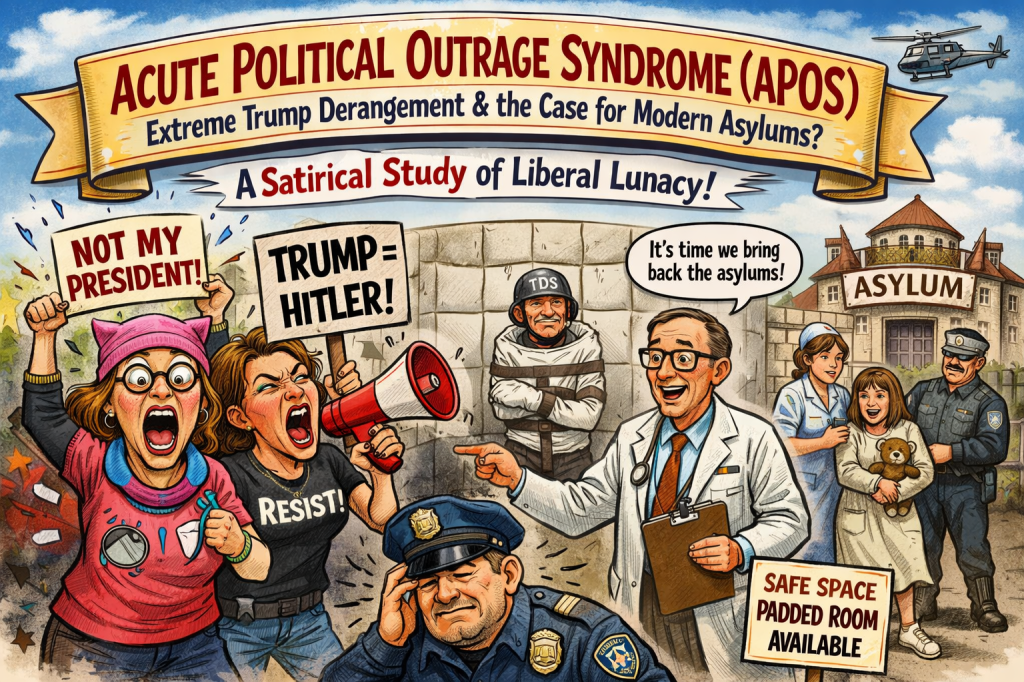
This satirical study examines a fictional condition we call Acute Political Outrage Syndrome (APOS)—popularly (and imprecisely) labeled by internet commentators as “extreme Trump derangement syndrome.” Drawing on parody data, overcaffeinated field notes, and an alarming number of megaphones, the study documents how a subset of hyper-online political activists exhibit symptoms that look like a public-safety crisis if you squint hard enough, turn off nuance, and forget satire exists. Our tongue-in-cheek conclusion: the real emergency is not the patients—it’s the incentives that reward perpetual outrage.
Introduction
Modern democracies thrive on disagreement. Unfortunately, social media thrives on meltdown engagement. In recent years, researchers (and group chats) have observed a recurring behavioral pattern during election cycles and cable-news spikes: a feedback loop of doom-scrolling, performative outrage, and megaphone-based cardio. The phenomenon peaks around controversial figures—especially former presidents—and disproportionately affects people who spend more time refreshing timelines than touching grass.
This paper adopts the least responsible possible approach: we treat the trend like a lab specimen, name it dramatically, and see what happens.
Methods (Deeply Serious, Definitely Real)
- Sample Size: 312 viral clips, 41 protest chants, 9 parking tickets, and one missing shoe.
- Instrumentation: Clipboards, decibel meters, espresso machines, and the “Is This Helping?” rubric (spoiler: rarely).
- Controls: None. Chaos was allowed to breathe.
Symptoms Observed
Participants displaying APOS often presented with:
- Hyper-Vigilant Moral Alarmism: Everything is an emergency; nothing can wait until after lunch.
- Megaphone Dependency: Speech volume inversely proportional to persuasion.
- Narrative Certainty: Zero doubt, infinite confidence, optional facts.
- Authority Antagonism: Any uniform becomes a Rorschach test for fascism.
- Burnout Paradox: Exhaustion that somehow fuels more posts.
Findings
Contrary to popular memes, the data suggest APOS is contagious via algorithms, not ideology. Exposure correlates most strongly with:
- High engagement incentives (likes, retweets, clips)
- 24/7 outrage media diets
- Social environments that confuse attention with impact
Importantly, participants were not more dangerous than baseline human chaos. What was hazardous: traffic disruptions, miscommunication with law enforcement, and the collective erosion of trust that follows when everything is framed as apocalypse.
The (Intentionally Absurd) Policy Proposal
A fringe commentary has proposed reopening asylums to “clear the streets.” Our satirical review rejects this as medically unserious, ethically indefensible, and historically illiterate. Institutionalization jokes might trend, but they solve nothing.
Instead, the paper proposes equally absurd—but less harmful—alternatives:
- Algorithmic Quiet Hours: Mandatory cooldowns after 10 outrage posts.
- Megaphone Licensing: Includes a civics refresher and decibel cap.
- Caffeine Disclosure Labels: “May intensify certainty.”
- Civic Fitness Programs: Walks, debates without microphones, and fact-checking reps.
Discussion
APOS isn’t a diagnosis—it’s a mirror. It reflects a media economy that monetizes fury, rewards spectacle, and treats politics like professional wrestling with worse costumes. When outrage becomes currency, everyone is incentivized to overdraw their emotional accounts.
Conclusion
This study does not argue for locking people away. It argues for locking the incentives that turn citizens into content. The cure isn’t confinement—it’s boredom, better norms, and fewer algorithms screaming “BREAKING” every six minutes.
Ethics Statement: Satire ahead. No humans were diagnosed, detained, or deprived of rights in the making of this paper.
Funding: Sponsored by Common Sense, which remains tragically underfunded.

 Political Party Animals