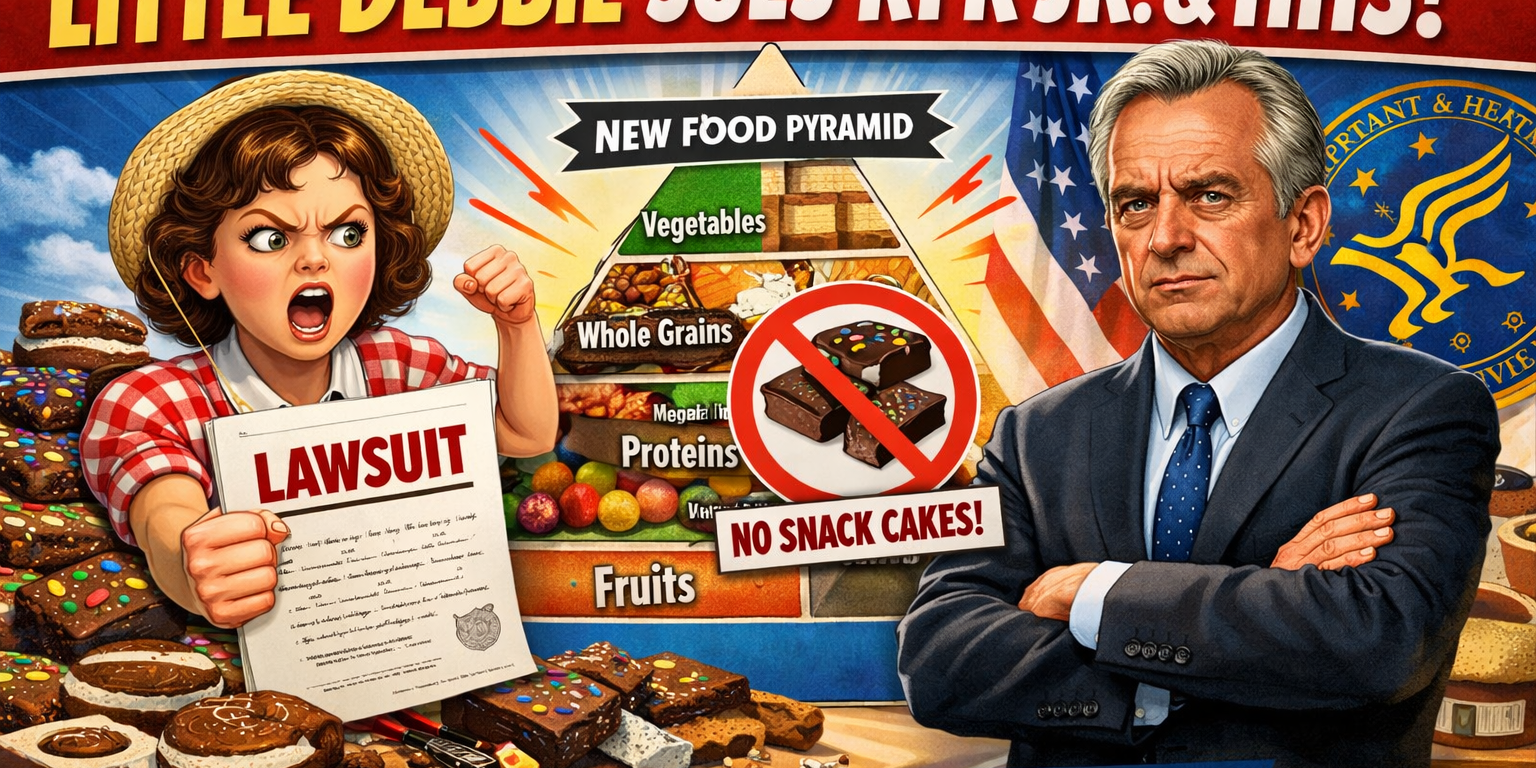

In what legal experts are calling “the most sugar-fueled constitutional crisis since the invention of Pop-Tarts,” Little Debbie announced this week that it has filed a lawsuit against Robert F. Kennedy Jr. and the U.S. Department of Health and Human Services after the beloved snack-cake empire was shockingly omitted from the newly released federal food pyramid.
According to the 47-page complaint—printed on pink paper and faintly smelling of chocolate frosting—Little Debbie alleges “nutritional discrimination,” “processed-food erasure,” and what it describes as “a deliberate attempt to cancel America’s childhood.”
“We Are a Food Group”
At an emotionally charged press conference, a visibly shaken spokesperson for Little Debbie stood in front of a pyramid made entirely of Oatmeal Creme Pies and delivered a statement that will be remembered for generations.
“For decades, Little Debbie has occupied a critical middle tier of the American diet—somewhere between ‘breakfast’ and ‘regret,’” the spokesperson said. “To be excluded entirely is not just insulting. It’s unconstitutional.”
The lawsuit argues that Little Debbie products are “culturally essential calories,” noting their historic role in school lunches, gas stations, break rooms, and late-night existential crises.
RFK Jr. Responds: “That’s Not Food”
The updated pyramid, released last week under RFK Jr.’s “Make America Metabolically Functional Again” initiative, emphasizes whole foods, clean ingredients, and the radical notion that items should technically be recognizable as food.
When asked about the omission, RFK Jr. was blunt.
“If it comes individually wrapped, survives a nuclear winter, and has a shelf life longer than most marriages, it’s not a food group,” he said.
Insiders say Kennedy briefly considered adding a “nostalgia tier” but ultimately decided against it after staffers failed to identify any known vitamin contained in a Cosmic Brownie.
Legal Strategy: Feelings Over Facts
Little Debbie’s legal team is reportedly pursuing several aggressive theories, including:
- Equal Protection for Pastries – arguing that sugary snack cakes deserve the same respect as fruits and vegetables.
- Due Process for Ding Dongs – alleging the pyramid was released without adequate notice to the frosting community.
- Freedom of Snacking – citing an implied constitutional right to eat something called a “Swiss Roll” without judgment.
One filing claims the pyramid unfairly favors elitist foods like quinoa and kale while “marginalizing blue-collar snacks that have never pretended to be healthy.”
Americans React
Public reaction has been sharply divided.
Nutritionists applauded the pyramid as a long-overdue correction, while millions of Americans stared at their lunch, quietly realizing it no longer qualified as a meal.
Social media erupted with hashtags like #JusticeForDebbie, #SnackGate, and #MyPyramidMyRules. One viral post read:
“First they came for the trans fats, and I said nothing. Then they came for Little Debbie.”
What’s Next?
If successful, the lawsuit could force HHS to add a new tier to the pyramid labeled “Emotionally Supportive Processed Foods.” Early drafts reportedly place Little Debbie above vegetables but below energy drinks.
Until then, Little Debbie has vowed to continue fighting.
“We’re not asking to be at the top,” the spokesperson said. “We’re just asking not to be buried underneath spinach.”
At press time, several Twinkies were seen observing a moment of silence.

 Political Party Animals