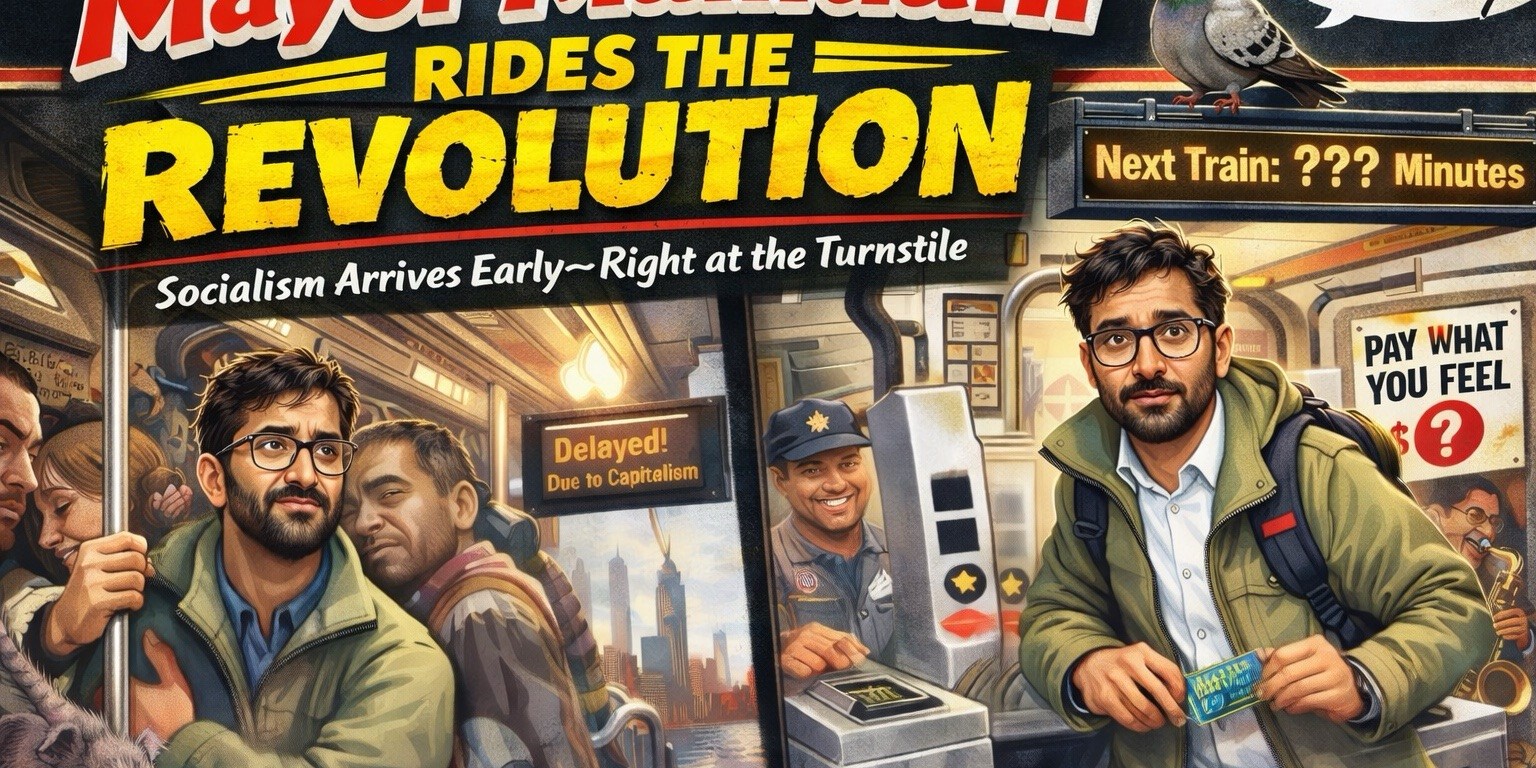
Socialism Arrives Early—Right at the Turnstile
In what City Hall officials are calling a “values-aligned commute,” New York City Mayor Zohran Mamdani was forced this week to take public transportation to work—after the policies he championed during his campaign began operating with stunning speed and absolutely no regard for his calendar.
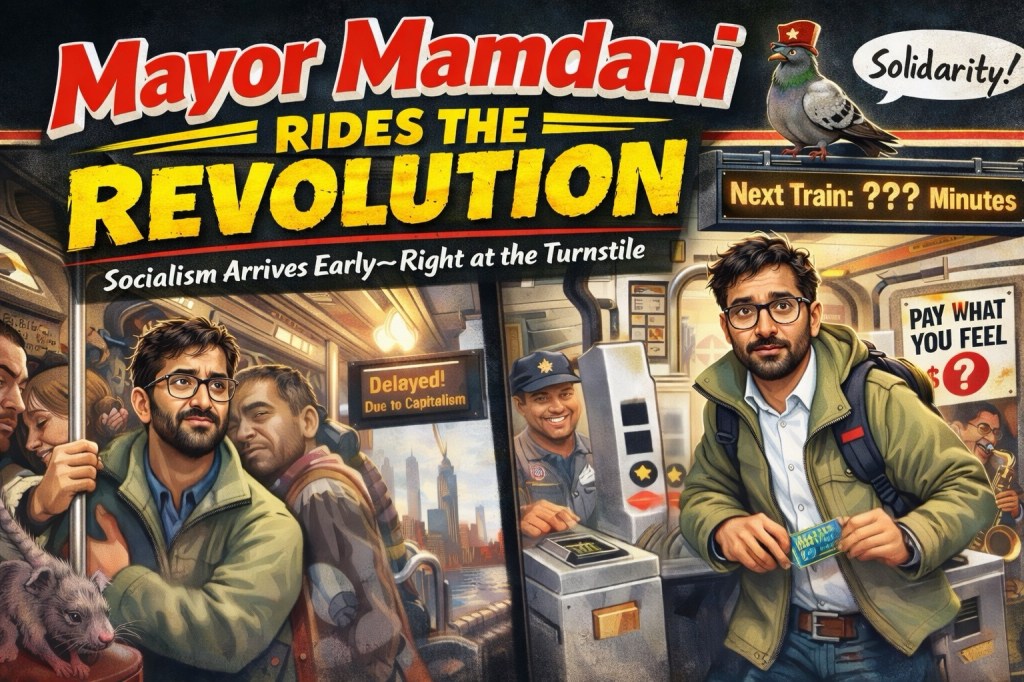
Gone were the chauffeured SUVs, the discreet security bubbles, and the comforting illusion that leadership exists separately from lived experience. Instead, the mayor was spotted descending into the subway system, clutching a MetroCard and hope in roughly equal measure, joining hedge fund analysts, exhausted nurses, performance artists, and one man openly eating tuna from a plastic bag before 8 a.m.
The trouble reportedly began when the mayor attempted to summon a car service, only to discover that dynamic pricing had been replaced with dynamic fairness, meaning all vehicles were currently “in community use” and expected to return once everyone had emotionally processed capitalism.
Undeterred, Mamdani entered the subway—the great equalizer, and now apparently, his office annex—where he waited 18 minutes on a platform beneath a sign reading: “Next Train: ??? Minutes.” The delay was attributed to a combination of signal issues, equity audits, and a pilot program exploring whether trains really need to arrive at all.
As mayor, Mamdani briefly considered calling the MTA commissioner—before remembering he appointed him.
When the train finally arrived, it did so violently, redistributing passengers according to a system best described as from each according to their balance, to each according to gravity. Mamdani was pressed into a pole, a backpack, and a manifesto written in Sharpie on the wall. His security detail followed at a respectful distance, pretending not to know him as he became physically absorbed into the constituency.
At the fare gate earlier, the mayor had attempted to enter using the city’s newly proposed Pay-What-You-Feel transit concept, only to be informed by an MTA employee that the idea had not yet cleared procurement, funding, or reality. He tapped his MetroCard like everyone else, proving once again that no ideology survives contact with a turnstile.
Mid-ride, the train stopped between stations. Over the loudspeaker came the familiar announcement: “We are being held momentarily,” which in MTA language translates to abandon all hope. A saxophone player launched into an unsolicited 11-minute solo. Someone started live-streaming. Democracy continued.
“This,” the mayor reportedly said while staring at the flickering route map and a slowly dripping ceiling panel, “is what accountability smells like.”
By the time Mayor Mamdani emerged onto the street—47 minutes late, lightly damp, and spiritually humbled—the lesson was unmistakable. Campaign slogans promise transformation, but governance arrives on a local train, crowded, delayed, and unapologetically real. New York had not rejected his vision; it had simply handed him the keys, the timetable, and the maintenance backlog. The revolution, it turned out, wasn’t theoretical anymore.
It was operational.
And it was his now.

 Political Party Animals