
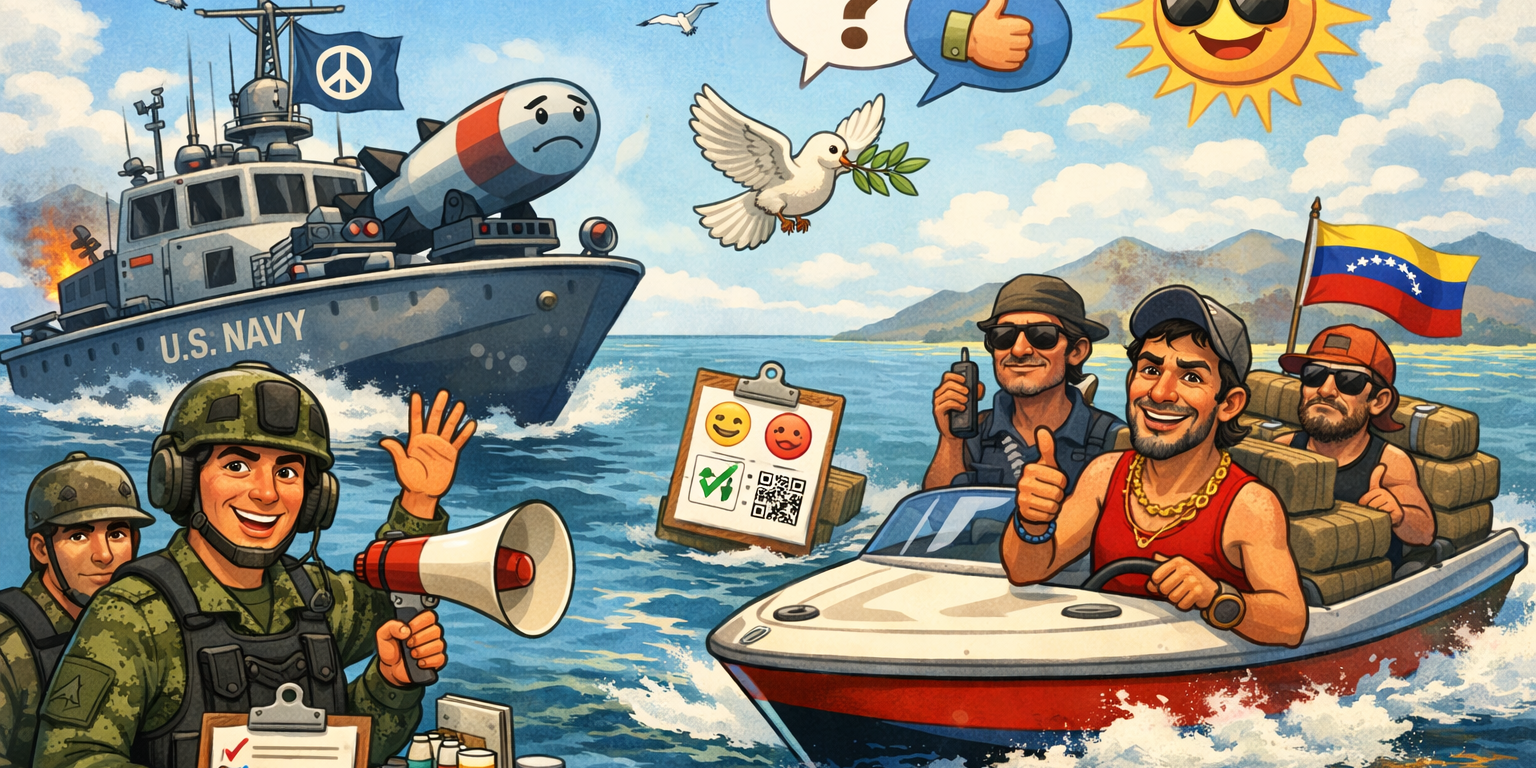
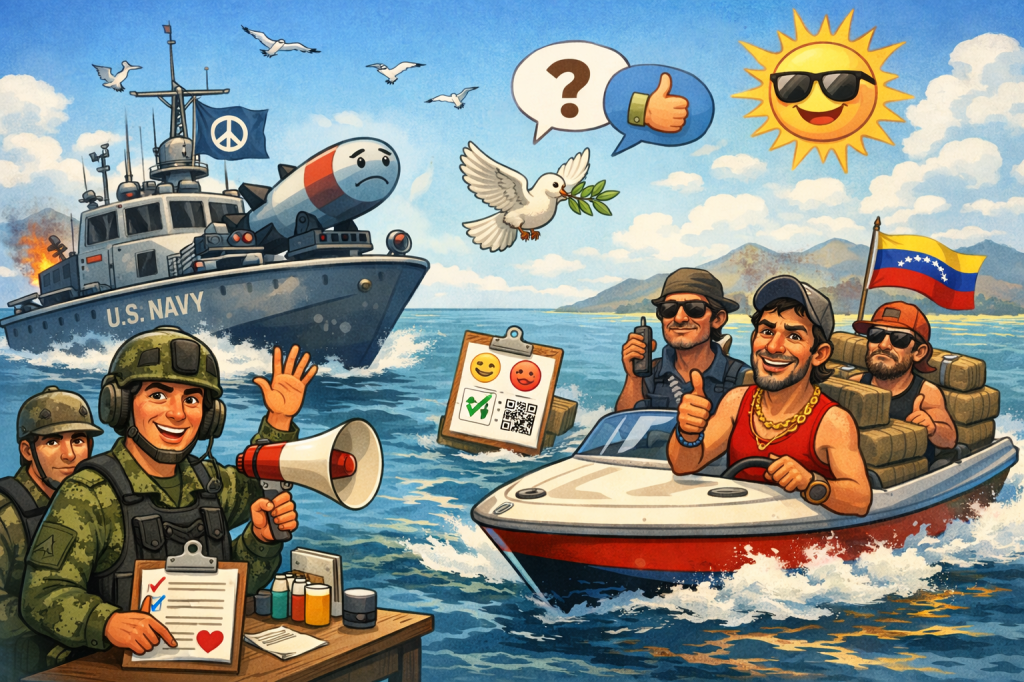
WASHINGTON, D.C. — In a stunning update to U.S. military policy, the Pentagon confirmed Monday that American forces must now politely request consent from suspected drug boat captains before taking any hostile action—following what officials described as “sustained pressure from the left and several very intense panel discussions.”
Under the new Rules of Engagement (ROE), U.S. naval commanders encountering narco-trafficking vessels originating near Venezuela are required to follow a strict escalation ladder:
- Identify the drug boat
- Establish eye contact
- Ask for pronouns
- Request verbal permission to engage
- Wait for a response
- Re-evaluate feelings
- File a consent acknowledgment form (DD-42069)
- Only then, consider thinking about blowing it to smithereens
“If the captain says no, or seems emotionally uncomfortable, we disengage,” said Rear Adm. Thomas Wainwright, reading from a laminated cue card. “If he says maybe, we schedule a follow-up conversation.”
“We’re Still Tough—Just More Respectful”
Pentagon spokespersons insisted the policy does not weaken national security.
“This is not about being soft,” said one official. “It’s about respecting maritime autonomy. We believe even heavily armed cocaine speedboats deserve a voice.”
Commanders are now instructed to hail suspected traffickers with the standard opening phrase:
“Hello. This is the United States military. We’re calling to ask if you’re okay with us neutralizing your vessel today.”
If the response is hostile—or worse, sarcastic—U.S. forces must disengage immediately and offer mediation.
Consent Denied, Missile Delayed
According to leaked guidance, if a drug boat captain refuses consent, U.S. forces may still deploy non-lethal options such as:
- A strongly worded radio message
- A disappointed sigh
- A warning flare shaped like a feelings chart
- A QR code linking to a DEI survey
Only after three refusals, two apologies, and a cooling-off period may commanders submit a request to Washington for “conditional kinetic discouragement.”
The approval process is expected to take 6–8 weeks, assuming the boat doesn’t disappear first.
Narco-Captains React Positively
Early reports suggest drug traffickers are embracing the change.
“I appreciate being asked,” said one anonymous captain while unloading several tons of narcotics. “Before, it was very hostile. Now it feels collaborative.”
Another reportedly replied, “No thank you,” before speeding away at 60 knots—an interaction Pentagon officials later described as a “successful de-escalation.”
Training Updates Already Underway
The military has begun rolling out new training modules, including:
- Active Listening Under Fire
- Missile Launch Hesitation Techniques
- De-escalation While Being Shot At
- How to Accept ‘No’ From a Cocaine Boat
Troops will also receive pocket-sized laminated cards reading:
“Blowing Stuff Up Is a Last Resort.”
Critics Raise Concerns
Some defense analysts worry the policy may complicate operations.
“At this rate,” one retired admiral said, “we’ll be asking pirates to sign consent waivers before returning fire.”
Others warned that future conflicts could require similar protocols.
“There’s concern this could extend to hostile aircraft,” said a defense aide. “We may soon be asking incoming missiles how they feel about being intercepted.”
Pentagon Reassures Public
Despite criticism, officials say the policy reflects modern values.
“We can be inclusive and explosive,” the Pentagon said in a statement. “Just not at the same time, and only if everyone agrees.”
As of press time, a U.S. destroyer was reportedly circling a suspicious speedboat, patiently waiting for a reply to its latest radio transmission:
“Hey there—just checking in. Following up on our earlier request. No pressure.”

 Political Party Animals