
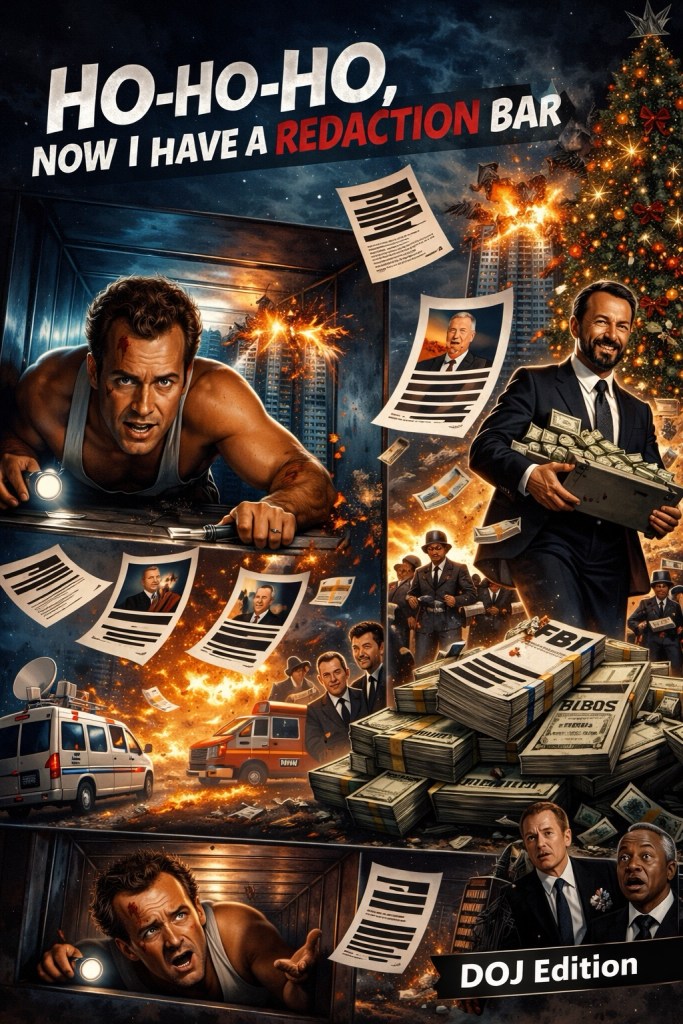
On December 19, 2025—just days before Christmas, when the nation traditionally argues about whether Die Hard is a Christmas movie—the Department of Justice decided to host its own holiday party.
They called it transparency.
Under a bipartisan Transparency Act signed amid the usual Trump-era fireworks, the DOJ released what it promised would be the Epstein Files dump: thousands of pages, photos, emails, flight logs, party guest lists, and enough blurred pixels to crash Adobe Photoshop.
The media lit up like Nakatomi Plaza.
Cable news helicopters hovered. Twitter went DEFCON 1. Liberals screamed “elite cover-up!” Conservatives yelled “nothingburger!” Internet sleuths sharpened their copy-paste tools. Everyone rushed to the 30th floor, where the Christmas party was already out of control.
The files themselves were… festive.
Entire pages were blacked out like ransom notes written by Sharpie enthusiasts. Faces were blurred—even people who had been publicly identified for years. Names disappeared, reappeared, vanished again. A photo involving Trump showed up, got pulled, then reappeared like a drunk uncle who keeps trying to rejoin the party. Clinton hot tub photos resurfaced—because of course they did—like it was 1998 and nobody had smartphones.
Then came the real gift:
“Oops. We found over a million more documents. Full release coming in 2026.”
The crowd roared. Victims called it a slap in the face. Lawmakers threatened contempt. Everyone accused everyone else of running cover. The DOJ assured the nation it had teams of lawyers working around the clock, which in government dialect means “someone emailed someone who is on vacation.”
Up on the roof, the explosions were spectacular.
Downstairs, nobody was watching the vault.
Because while America was glued to redaction bars and conspiracy threads, Hans Gruber was already at work.
Not the accent-heavy European kind. The modern kind. The sleek, spreadsheet-fluent, “totally legal until it isn’t” kind. Corporate fraud. Embezzlement. Quiet bankruptcy engineering. Time theft. Accounting magic. The boring crimes—the ones that don’t come with photos, names, or hot tubs.
While pundits debated whether a black rectangle covered a billionaire or a bellhop, corporate America drilled through the basement floor.
Airlines folded. Retailers collapsed. Food companies quietly filed Chapter 11. Employee pensions evaporated like Christmas bonuses in January. County treasurers vanished with $38 million. Tribal funds went missing. Internal audits were delayed. Whistleblowers were laid off “for performance reasons.”
But hey—did you see Page 742? Someone’s name might be under that bar.
This was the perfect heist.
The Epstein Files weren’t evidence—they were hostages.
And the DOJ played the role of the LAPD beautifully.
“We have the situation under control.”
“We’re protecting victims.”
“We ask the public for patience.”
Meanwhile, the ambulance backed up to the loading dock.
John McClane—also known as the average American—was crawling through the vents, barefoot, muttering about redactions. He fired off tweets. He yelled “Yippee-ki-yay!” at strangers online. He knew something was wrong. He just couldn’t see where.
Because every time he looked down, the camera cut back to the rooftop.
The media helped. Breathless coverage. Endless panels. Experts explaining why a black bar could mean anything. Ratings soared. Nobody wanted to talk about fraud losses measured in billions, because that doesn’t trend. No photos. No villains. No conspiracy corkboards.
And Hans Gruber?
He didn’t need detonators.
He had distraction.
By the time the credits rolled, the DOJ promised reforms, the politicians promised hearings, and the media promised more coverage coming after the holidays.
The vault was empty. The ambulance was gone. The bonds were laundered through tax havens wearing Santa hats.
And somewhere in Washington, a bureaucrat looked at a fully blacked-out page and whispered,
“Ho. Ho. Ho.”

 Political Party Animals