
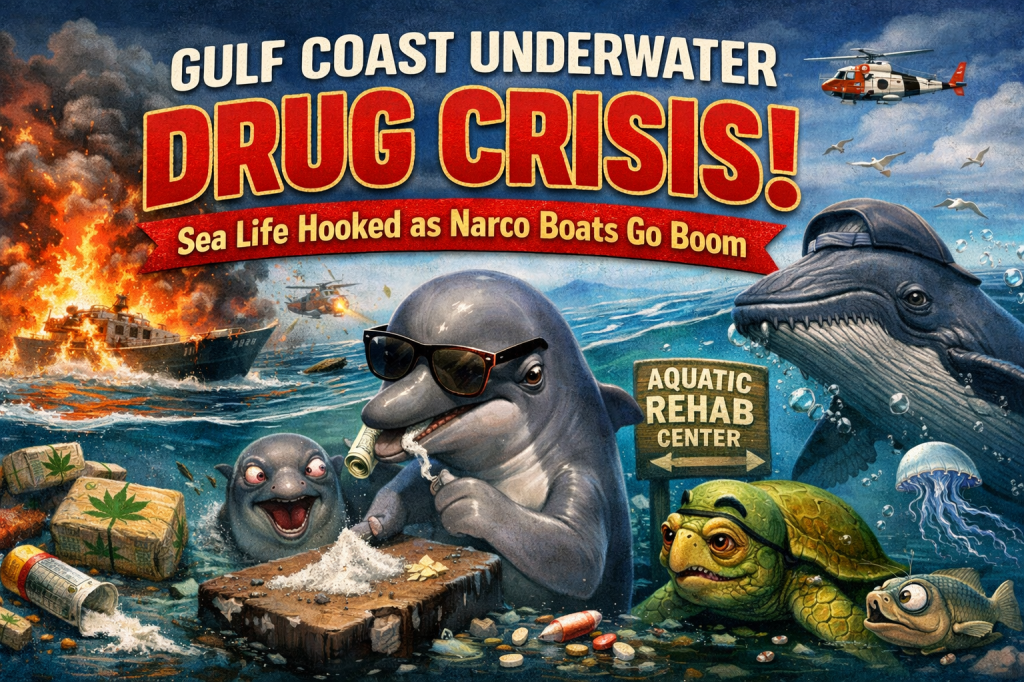
WASHINGTON — Federal officials confirmed this week that America’s war on drugs has taken an unexpected turn: it has apparently been won at sea, but lost to the sea.
According to a hastily assembled interagency report, there has been a “dramatic rise in substance dependency behaviors” among marine life in the Gulf of America, a phenomenon scientists are delicately calling Collateral Aquatic Intoxication and everyone else is calling “the dolphins are absolutely cooked.”
The cause, officials say, is simple physics and aggressive foreign policy. For years, the U.S. military has heroically intercepted narco-boats by blowing them into artisanal reef fragments, sending metric tons of narcotics directly into the ocean — where fish, whales, turtles, and at least one extremely confident octopus have reportedly developed troubling habits.
“We were very effective,” said one Pentagon spokesperson. “Unfortunately, the ocean was standing directly behind the target.”
Dolphins Showing Signs of Dependency
Marine biologists report dolphins exhibiting erratic behavior, including clicking at unusually fast tempos, demanding snacks aggressively, and refusing to swim unless a DJ is present.
“One pod has started calling itself The Narcosonics,” said Dr. Elaine Mercer of the National Oceanic and Atmospheric Administration. “They circle shrimp boats like club promoters and keep asking if anyone has ‘the good stuff.’”
A separate study found several dolphins attempting to barter seashells for Red Bull, while a manatee was observed floating motionless for six hours, insisting it was “just vibing.”
Sea Turtles Enter Rehabilitation
Sea turtles have not been spared. Wildlife officials confirmed the opening of the nation’s first Aquatic Rehabilitation and Sobriety Center, where turtles are encouraged to “take it one tide at a time.”
“Before the explosions, these turtles were disciplined,” said a volunteer counselor. “Now they’re skipping migration, wearing tiny sunglasses, and saying things like, ‘Relax, man, I’ve got this current handled.’”
One turtle reportedly failed a sobriety test after drifting into a Coast Guard buoy and blaming the buoy for “moving weird.”
Whales Demand Harm Reduction
Perhaps most concerning are the whales. Several pods have filed what activists are calling a Cetacean Class Action, demanding harm-reduction policies, clean injection sites (defined as “literally anywhere else”), and a temporary halt to exploding speedboats in their feeding grounds.
“These whales are enormous,” said one environmental lawyer. “If they’re addicted, imagine the tolerance.”
Underwater microphones captured one humpback remixing its mating call into what analysts described as “a 90-second bass drop.”
Pentagon Responds
Defense officials insist the military followed protocol.
“Our objective was to keep drugs off American streets,” said a senior defense official. “We did not anticipate the ocean having a street.”
The Pentagon has proposed several solutions, including biodegradable explosives, underwater warning labels, and a new pilot program encouraging narco-boats to please, respectfully, stop before being detonated.
Until then, officials advise Americans to remain calm.
“There’s no evidence the fish are selling,” said one spokesperson. “Yet.”
As for the dolphins, authorities say intervention is ongoing — though one pod was last seen speeding alongside a Coast Guard cutter, chanting, “Just one more shipment, bro.”

 Political Party Animals