
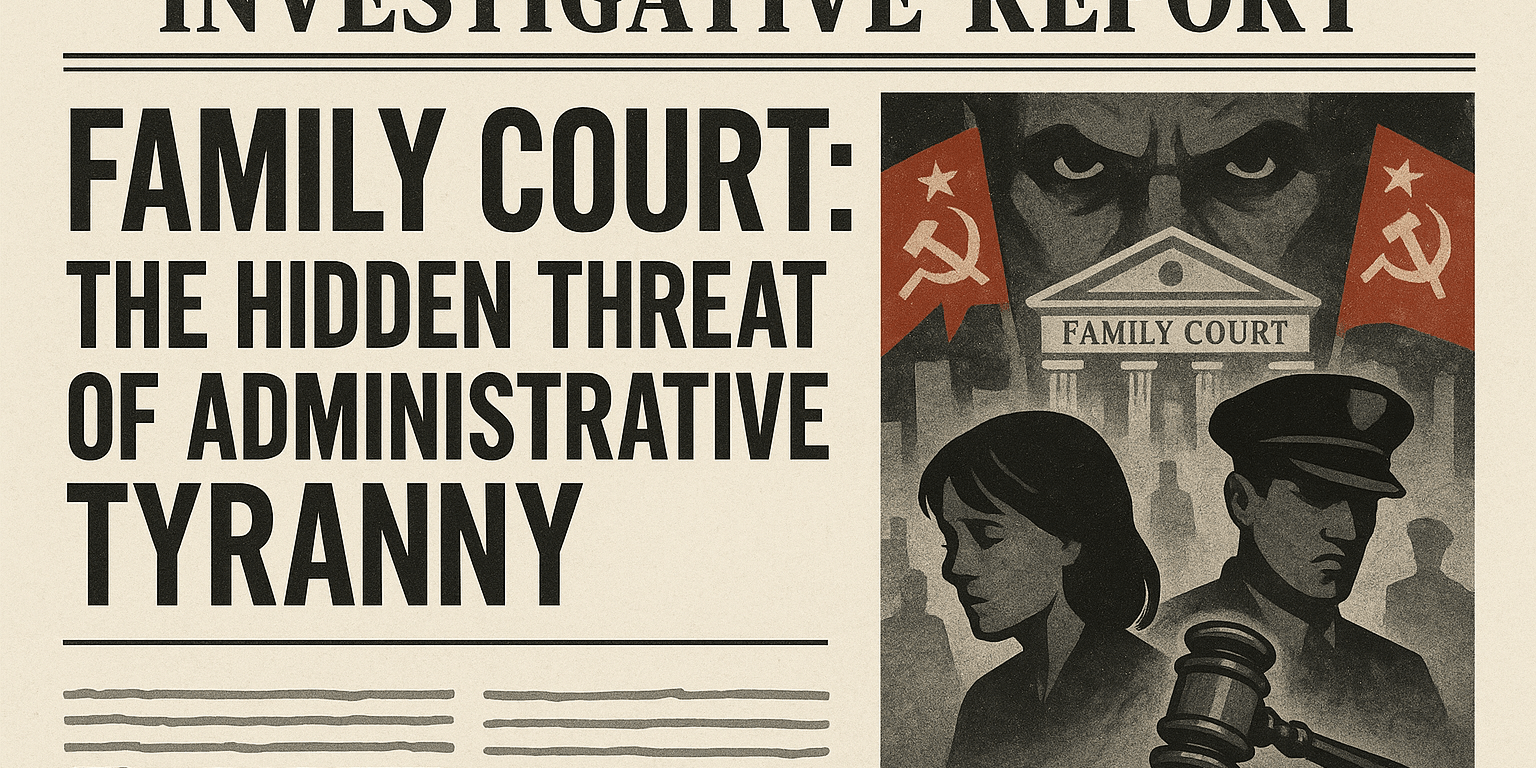
How America’s family courts evolved into closed-door administrative tribunals — and why parents are fighting back.
Most Americans think “going to court” means constitutional protections — due process, evidence, cross-examination, a judge bound by law.
In Family Court, that’s often a dangerous illusion.
Family courts today operate more like administrative enforcement agencies than judicial courts. What’s at stake isn’t just property or money — it’s families, parental rights, and the futures of children.
And increasingly, parents, survivors, and grassroots advocates are calling it what it is: a hidden system of administrative governance, not constitutional justice.
The Administrative Evolution of Family Court
Family court wasn’t always this way. But over the past 30 years, a series of reforms and funding changes quietly shifted it into administrative territory:
- 1990: Judicial Improvements Act.
Congress pushed ADR (Alternative Dispute Resolution) into civil law, including family cases, favoring settlement and mediation over trials. - 1994: Violence Against Women Act (VAWA).
VAWA created financial incentives for states to route domestic violence claims through civil courts instead of criminal prosecution — prioritizing quick interventions over due process protections. - 2000: Troxel v. Granville.
The Supreme Court acknowledged parental rights as fundamental — but at the same time upheld broad judicial discretion to override them. Family courts were empowered to act not based on hard constitutional standards, but on subjective “best interests” assessments.
At every stage, constitutional protections were softened, policy discretion expanded, and the administrative model deepened.
Today’s Reality: Family Court as Administrative Enforcement
In practice, family court litigants now face:
- No right to a jury trial.
- Limited right to confront accusers.
- Broad judicial discretion to label parents “unfit” without a full evidentiary hearing.
- Forced participation in ADR programs — at personal cost.
- Secret proceedings hidden from public scrutiny.
Judges act more like administrators than neutral adjudicators.
Court-appointed professionals profit from mandatory services.
And families are treated as public policy problems, not rights-bearing citizens.
A sign seen at a recent protest summed it up:
“I APPEAR UNDER PROTEST, THREATENED BY ADMINISTRATIVE ENFORCEMENT — NOT TRUE JUSTICE.”
The Role of Money and Incentives
Family court’s administrative expansion didn’t happen in a vacuum.
It’s powered — and sustained — by money:
- Federal and state grants tied to domestic violence interventions, child support enforcement, and court modernization initiatives.
- ADR program funding rewarding high settlement and compliance rates.
- Mandatory services generating steady revenue for mediators, evaluators, and attorneys.
The system, critics argue, has created a perverse financial structure:
the more accusations, the more interventions, the more funding.
And in this system, a parent’s constitutional rights are often seen as inconvenient obstacles — not foundational principles.
Is the System Cracking?
There are signs of resistance:
- Federal Defunding:
The Trump administration reduced funding for several grant programs that indirectly sustained ADR-based family court structures. - Public Outcry:
Grassroots movements of parents, survivors, and civil liberties advocates are shining light on the hidden administrative nature of family court. - Legal Challenges:
Some litigants are pursuing constitutional appeals, seeking to restore real due process protections in family matters.
Still, meaningful reform remains an uphill battle. Family courts operate under the cover of confidentiality, and political appetite for full-scale reform has lagged behind public outrage.
Conclusion: A Choice About Justice
America must confront an uncomfortable question:
Should family court cases involving fundamental rights — parental custody, allegations of abuse, the fate of children — be decided through administrative processes or constitutional trials?
The answer will determine not just the future of family law — but the future of family itself.
Until then, behind closed courtroom doors, administrative enforcement continues.
Families are managed, judged, and broken — often with little more than a polite signature on an administrative order.
Justice demands more.
Do you think family court should require full constitutional protections?

 Political Party Animals