
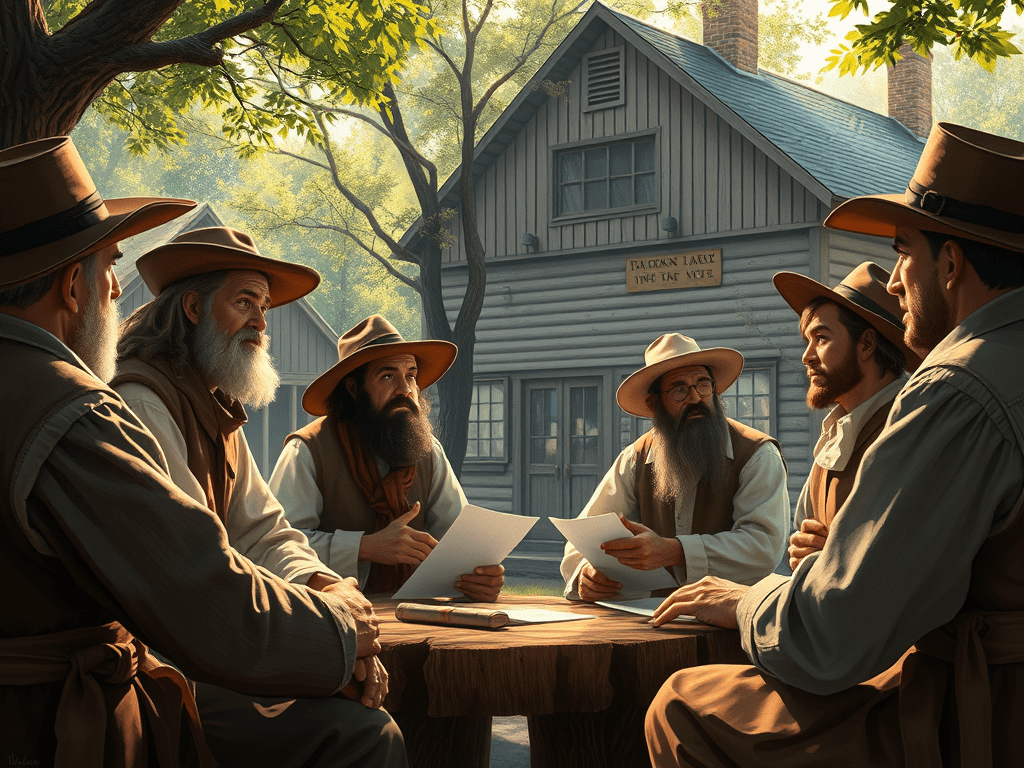
Imagine building a new society from scratch. You escape tyranny, you cross an ocean, you fight off disease, famine, and angry wildlife. You set up towns and churches and basic courts — and right at the start, you make a brilliant decision:
You ban the lawyers.
The early American colonists, often portrayed today as stiff Puritans and prudish settlers, actually showed a level of wisdom that modern America could only dream of: they saw the future coming — and they wanted no part of it.
In the Massachusetts Bay Colony, for example, the Puritans flat-out refused to allow professional lawyers into their courts. Why? Because they understood something fundamental about human nature:
The more you professionalize conflict, the more conflict you get.
They believed that disputes should be settled by neighbors, by elders, by church leaders — not by men (and it was always men) who would twist truth into strategy for a fee. In their view, lawyers didn’t bring clarity or justice. They brought manipulation, delay, division, and greed.
Virginia wasn’t far behind. In 1642, the General Assembly passed a law banning lawyers from charging fees. If you wanted to represent yourself, fine. If you wanted to speak for a friend, okay. But if you wanted to profit from dragging your neighbor through court?
Absolutely not.
Connecticut took a similar approach. The message was clear: you can have disputes, but you must solve them as people, not as pawns on a legal chessboard operated by professionals paid to win at all costs.
In other words, the colonists understood the stakes. They knew that legalism — the obsession with rules, technicalities, and endless adversarial combat — could hollow out a community just as surely as famine or war.
They were not “unsophisticated.”
They were wise enough to protect peace before they protected procedure.
Fast Forward to 2025
Today, America is drowning in lawyers.
We have more lawyers per capita than any other country in the world. We have entire television networks dedicated to true-crime court drama. We have college students graduating with six figures of debt and three years of indoctrination in how to turn every human conflict into an endless paper trail.
Want to get divorced? Lawyer up.
Want to settle a property line? Lawyer up.
Want to see your own child after a breakup? Lawyer up… and good luck.
Instead of community, we have litigation.
Instead of neighbors working things out, we have formal discovery, depositions, subpoenas, motions, and appeals.
Instead of peacemakers, we have “counselors at law” trained to treat every problem as a chess match with a personal financial bonus attached.
We don’t solve problems anymore.
We sue them.
The colonists, for all their faults, looked at this future and said:
“Not on our watch.”
And yet here we are, two centuries later, paying $500 an hour to men and women in tailored suits to argue about who gets the lawn chairs.
Maybe the Colonists Weren’t So Primitive After All
It’s fashionable to sneer at the early Americans as simplistic, backward, or naïve.
But maybe, just maybe, they had a better sense of human nature than we do.
Maybe they knew that building a decent society required limits — not just on the people who govern, but on the systems that can be corrupted.
And maybe banning lawyers — or at least severely limiting their role — wasn’t the act of a primitive people.
Maybe it was the act of a people who knew exactly what they were doing…
and were smart enough to stop us from becoming exactly what we have become.
Maybe it’s time we took a page from the 1642 Virginia Assembly… and told the lawyers to take a hike.

 Political Party Animals